
Waning Compliance, Mounting Violations: Prelude to the Edgar Thomson Works Consent Decree

Updated: May 12

When discussing major air polluters in Allegheny County, U.S. Steel’s Mon Valley Works (composed of the Clairton Coke Works, Irvin Works and Edgar Thomson facilities) is among the first to come to mind.
And for good reason: The Clairton Coke Works has been in the news for perennially polluting air in the Mon Valley and beyond for YEARS, with mounting enforcement actions issued by the Allegheny County Health Department for everything from hydrogen sulfide exceedances to pushing violations.
But Edgar Thomson’s impact on Mon Valley ambient air quality cannot (and should not) be ignored. Operations at the facility have largely gone under the radar since a high-profile 2022 consent decree reached by the U.S. Department of Justice (DOJ), EPA, ACHD, and U.S. Steel that addressed waning compliance.
Until now.
As part of our watchdog work, GASP staff researched the history of Edgar Thomson’s air quality violations, revisited the terms of the consent decree, and made public records requests to help shed light on what required operational, equipment and maintenance changes have been made, what’s still in the works, and what’s still up in the air.
The four-part series you are about to read is months in the making and includes information gleaned from online research and scores of documents obtained through the Right to Know process.
While the high-profile settlement agreement was finalized in December 2022, the story of Edgar Thomson’s descent into noncompliance with air quality rules began years earlier.
So, we need to rewind all the way back to 2016: Donald Trump had just been elected to his first term as President of the United States. Brexit was making international headlines, and right here in Pittsburgh, the Edgar Thomson Works came out of the gates that year with a spate of air quality violations that spanned the entire year.
U.S. Steel racked up enforcement actions for everything from violating opacity limits to blowing past fugitive emissions standards. Here’s a look at one of those enforcement actions:

After an employee complaint spurred an OSHA investigation, U.S. Steel was also fined $170,000 for how it handled asbestos abatement at Edgar Thomson. From the OSHA report:

That pattern of noncompliance continued into the new year, with ACHD issuing the first of many notices of violation to U.S. Steel just four days into 2017. The issue? Inspectors noted visual emissions opacity violations at the facility - an issue U.S. Steel would be dinged for again in February.
Air quality troubles continued for the company in April of 2017, ACHD deemed U.S. Steel’s annual certificate of compliance for 2016 as non-compliant. Not only did U.S. Steel got tagged with three more notices of violation for visible emissions violations and for violating other terms of its Title V operating permit.
The problem regulators flagged? For one, that U.S. Steel failed to properly maintain and repair inoperable rotary valves necessary for the proper operation of Edgar Thomson’s air pollution control equipment on both Feb. 4 and Feb. 17, 2017.
U.S. Steel continued to rack up enforcement actions for violating local air quality rules as well as the terms of its Title V - with ACHD noting two such infractions in May, six more in June, and another two in July.
This flurry of activity culminated with a Nov. 17, 2017 announcement that made headlines here in Pittsburgh and beyond: That EPA and ACHD had issued a joint notice of violation against U.S. Steel for myriad violations related to blast furnace and BOP Shop operations – among other things – at Edgar Thomson from 2016 through July 2017.
An ACHD press release regarding the NOV explained, “The nature of the violations includes excessive visible emissions, failure to maintain equipment and failure to certify compliance with the plant’s Title V operating permit.”
Via open records requests, GASP determined that 2015 and 2017 site inspections showed several blast furnace equipment deficiencies. You can view six examples here.
As for EPA’s role, ACHD explained:
“To enhance the Health Department’s enforcement efforts, ACHD has actively engaged the EPA over the course of the last nine months. The EPA brings an expanded level of federal expertise, as well as additional enforcement capacity that will support stronger action by utilizing the Department of Justice and EPA’s capacity to enact more stringent penalties.”
What happened next? A bunch of silence from regulators - for YEARS - even as U.S. Steel continued to buck air quality rules and violate the terms of Edgar Thomson’s operating permit.
Now, let’s fast forward to 2020 - when GASP began demanding an update from regulators about the status of that 2017 enforcement order and what exactly they were doing to force U.S. Steel to FINALLY bring Edgar Thomson into compliance with air quality rules following myriad pollution episodes at the facility.
For example: U.S. Steel on March 26, 2020, made a report to the U.S. Coast Guard National Response Center (NRC) at 9:11 p.m. concerning a release into the open air of approximately 100 pounds of anhydrous ammonia.

Then, on June 17, 2020, GASP flagged a dark brown plume emanating from the Edgar Thomson Works and demanded information from the company and ACHD.
On June 25, 2020, ACHD announced a sulfur dioxide (SO2) exceedance at the North Braddock air monitoring station that occurred that day. It also announced the brown plume emanating from the Edgar Thomson Works June 17 was the fault of a valve failure at the plant.
In early August, GASP announced the launch of a petition demanding EPA and ACHD to provide a formal update - noting four years of radio silence from the regulators.
Despite those pleas, regulators stayed mum, all while Edgar Thomson’s history of fouling the Mon Valley’s air continued.
In January of 2021, ACHD issued an enforcement order against U.S. Steel for a failed stack test at Edgar Thomson and assessed an $8,000 civil penalty.
Remember that report U.S. Steel made regarding that release of 100 pounds of anhydrous ammonia? ACHD issued an enforcement order against U.S. Steel for failing to report that breakdown in a timely manner as required by its Title V operating permit in February 2021. A $4,165 civil penalty was assessed.
Then in August 2021, there was another high-profile air pollution incident at the facility.
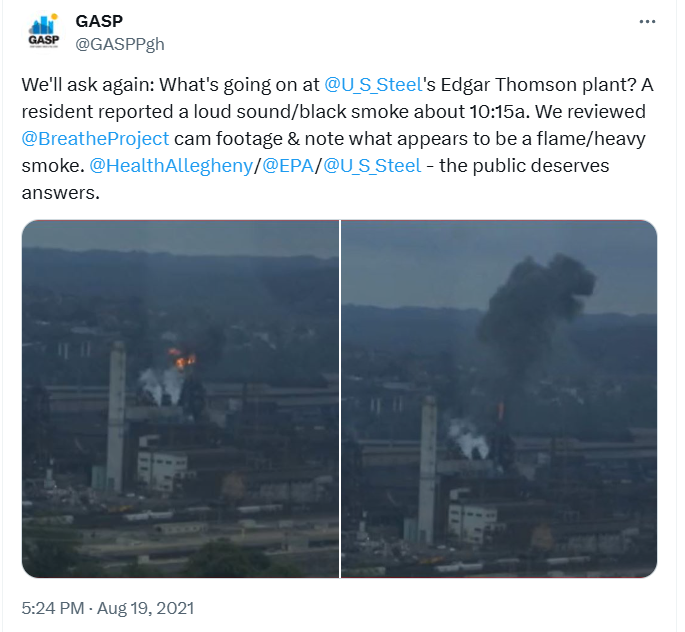
In an interview with WESA, then-Executive Director Rachel Filippini said:

“This lack of transparency… is very frustrating for people that have to live with the brunt of this pollution day in and day out. People deserve to have answers, they deserve to know what caused it and how it will be addressed. And ultimately, how can they know that it’s not going to happen again?”
GASP’s and others’ calls for transparency continued through 2021 and 2022 via public comments to the board of health, conversations with ACHD, social media posts, and rallies.
Then came the big news May 17, 2022: A deal had been reached. U.S. Steel had agreed to pay a $1.5 million penalty and make extensive improvements at its Edgar Thomson facility in Braddock Borough as part of a consent decree announced with EPA and ACHD to settle those longstanding air pollution violations.
Here’s what a release issued by the EPA said:
"Everyone has the right to clean air, and the Allegheny County Health Department continues to work to ensure that right for all residents,” said ACHD Director Dr. Debra Bogen, Director of the Allegheny County Health Department. “This settlement is another step toward that goal in Braddock and surrounding communities, many of which are designated environmental justice communities. We are pleased that a large portion of the Health Department’s share of the civil penalty will directly benefit Braddock and other Mon Valley communities that experience a disproportionate share of the environmental impact of the pollution this consent decree concerns."
The settlement mandated U.S. Steel make numerous improvements in training, monitoring and work practices to increase compliance and timely response to air pollution. Additionally, the company was tasked with conducting studies on potential improvements to its pollution control systems.
The settlement also includes a supplemental environmental project solely credited against ACHD’s share of the penalty in which U.S. Steel would provide funding to the Allegheny County Department of Economic Development for a specific environmental project.
Specifically, U.S. Steel will provide $750,000 in funding to the Allegheny County Department of Economic Development in support of the creation of a multimodal connection trail for hikers and bicyclists that links the Great Allegheny Passage in Rankin Borough to the Westmoreland Heritage Trail in Trafford Borough through the Turtle Creek Valley.
The project’s aim was to create another multimodal connection to communities near U.S. Steel Edgar Thomson Works, including Rankin, Braddock, North Braddock, East Pittsburgh, Turtle Creek, Wilmerding, Monroeville, Pitcairn, and Trafford, North Versailles, East McKeesport and Wall.
The then-draft settlement was subject to a public comment period. Despite robust comments submitted by residents and nonprofits like GASP, the deal was finalized Dec. 16, 2022, with zero changes made, reflecting that ACHD and EPA declined to implement any input gleaned from that process.
What exactly did the consent decree mandate? GASP will explore that and more in Chapter 2.


Comments