
How Wildfire Smoke Tanked Pittsburgh Air Quality (Again) & How New County Emergency Alert System Helped Keep Folks Informed

The latest round of Canadian wildfire smoke descended on southwestern Pennsylvania Thursday and lingered into the weekend, ushering in Air Quality Index values that soared into the Code Maroon range, prompting a spate of warnings from state and local officials.
How Social Media Played a Role
Meanwhile, social media platforms were blowing up with posts showing sepia-toned skies that obscured Pittsburgh’s iconic skyline.
EarthCam and CMU CREATE Lab's BreatheCam footage showed these views:

Journalists like our friend Natalie Bencivenga took to Instagram to help keep people informed on what they were seeing, smelling, and breathing:
One local physician used her feed to educate followers about just how bad our local air quality was, and what physical symptoms they could be experiencing as a result of the spiking AQI. Her name is Dr. Natalie Gentile, and her Instagram video went viral:
Residents Share Fears, Physical Symptoms on SmellPGH
Meanwhile, SmellPGH users provided a glimpse into what residents were experiencing:
This latest episode of (very) bad air quality also coincided with one of Pittsburgh’s most popular outdoor festivals: Picklesburgh. Social media lit up with people asking, “Is it even safe to attend?”
The question showed up in community Facebook groups, on Reddit, and was fodder for at least one conservative talk radio show (not linking because we don’t want to give a troll more traffic).
It was also discussed on the popular social media site oneBURGH, where they called out KDKA for what it deemed as irresponsible reporting on a burgeoning public health issue:
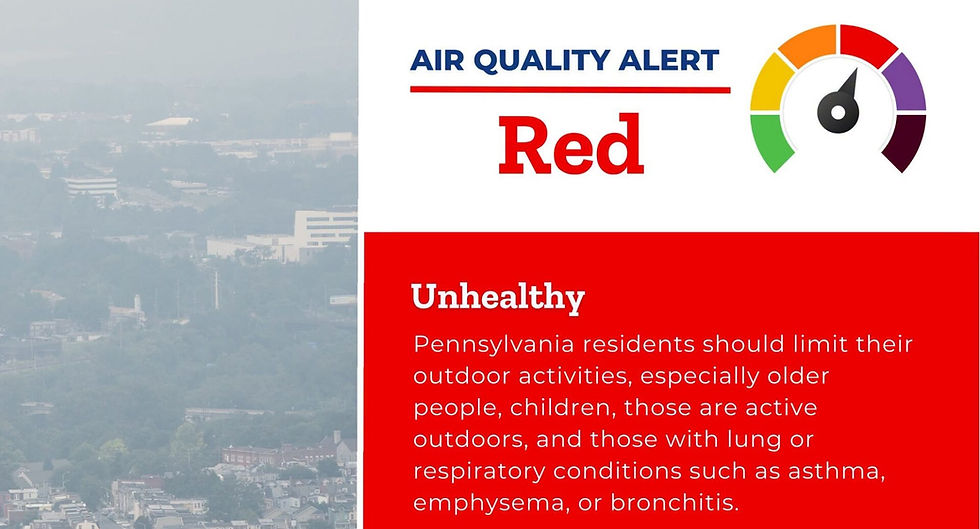
But how bad was the air we were all breathing? Consider this information shared Friday by ACHD:
News reports also indicate that UPMC emergency rooms saw an uptick of people seeking medical treatment for heat and air quality-related ailments.
Air Quality Extenuating Circumstances
We would be remiss if we didn’t mention two high-profile events that took Thursday as our area was already grappling with unprecedented air pollution:
First, there was the long-awaited explosion of the Commercial Street Bridge in Pittsburgh that the media aptly said left behind “nothing but a cloud of smoke and a pile of rubble” - timing that baffled residents and activists.
Then, there was a fire Thursday night at an industrial facility on Neville Island - Gottlieb Aluminum Recycling Inc. - that alarmed local residents and further fouled local skies.
GASP Communications Manager Amanda Gillooly, who lives near Gottlieb, captured video of massive dark plumes of smoke emanating from the facility - one she said she and neighbors have made reports about for years.
While we know there was a huge emergency response to the fire - with 19 departments responding - the cause of the blaze and the extent of the damage was not immediately known. Stay tuned, GASP is working to get more details.
What Went Right
One bright spot? Allegheny County Health Department’s robust response and public communications - from news releases distributed through the Allegheny Alerts system to actionable and informative social media posts, GASP appreciates ACHD’s diligent work.
“The last time wildfire smoke rolled into our region and caused significant air quality issues, ACHD did not have an emergency alert system in place - a problem we repeatedly implored the department to correct,” GASP Executive Director Patrick Campbell said. “This time around, residents were able to receive important public health information directly from the department instead of having to rely on news coverage or seeing something on social media.”
He continued:
“We thank ACHD for stepping up its crisis communications and truly helping to inform folks during some of the worst air quality many of us have seen in our lifetimes.”
GASP encourages everyone to sign up to receive alerts through the new county system - here’s what you need to know. We also encourage folks to bookmark AirNow.gov and/or download the app. Also follow GASP on Facebook, Instagram, and Bluesky for educational material and alerts.
Editor's Note: Who can you trust when the world is on fire? You can trust GASP to bring you timely, actionable information when you need it most.
When wildfire smoke sent local AQI soaring, Southwestern Pennsylvanians were left wondering how to keep their families safe. That's where GASP came in: From breaking down complex particulate pollution updates into clear, real-time guidance to giving residents practical resources to protect their health, GASP served as Pittsburgh’s reliable frontline defense.
But keeping our region educated, vigilant, and vocal takes year-round resources.
When the air gets heavy, our work gets critical. Help us keep Southwestern Pennsylvania informed, empowered, and breathing easier. Make a donation to GASP today.


A conversation about learning photography through constructive feedback seems most useful to me when it leaves space for uncertainty and further questions. A comment about light or framing is more useful when it explains what the viewer noticed. It also gives the phrase photography feedback tips a clearer meaning than a label on its own. I do not have a settled view yet, but this seems like a good place to slow down and look more closely. How can a photography discussion remain encouraging while offering specific criticism?
What interests me about exploring stories through creative reading is how a broad idea becomes part of an ordinary day. A character's journey can become a starting point for imagining a different place or perspective. I would use that point as a starting question when considering creative reading activities. The part I would like to explore further is what happens when the idea meets a real situation with its own limitations. How would you encourage readers to connect a story with their own questions?
The topic of learning from subject specialists gives me a few things to think about, especially when the discussion moves beyond general advice. A specialist's example can show how a broad principle applies to a particular problem. That is the kind of detail I would keep in mind while exploring expert learning guidance. The part I would like to explore further is what happens when the idea meets a real situation with its own limitations. What makes an expert explanation useful to someone with little background knowledge?
Thinking about exploring the relationship between nature and wellbeing, I find the smaller practical questions more interesting than a quick conclusion. Noticing a familiar outdoor place can offer a simple starting point for thinking about our surroundings. It also gives the phrase ecopsychology and wellbeing a clearer meaning than a label on its own. I would probably come back to this question after trying to work through one concrete example rather than deciding immediately. How could a nature activity leave space for different personal responses?
I can see why exploring nature and local life in Gorzno would invite discussion, since different people will bring different experiences to the same question. Careful observation can make a familiar landscape feel less ordinary. I would use that point as a starting question when considering Gorzno nature exploration. I am more curious about the process than a polished result, because the steps in between are usually where questions appear. What would you record during a short local nature walk?